(a) Define the following terms:
hay
silage.
(b)(i) Name two types of pasture.
(ii) State four advantages of establishing a grass-legume pasture.
(iii) State three advantages of rotational grazing. [3 marks]
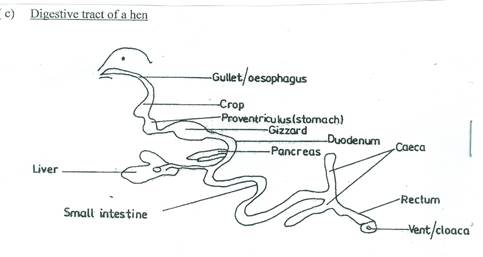
(c) Draw and label the digestive tract of a hen.
hay
silage.
(b)(i) Name two types of pasture.
(ii) State four advantages of establishing a grass-legume pasture.
(iii) State three advantages of rotational grazing. [3 marks]
(c) Draw and label the digestive tract of a hen.
Take Free Practice Test On 2026 JAMB UTME, Post UTME, WAEC SSCE, GCE, NECO SSCE
Correct Answer: Option
Explanation:
a) Definition of the terms hay and silage;
(i) Hay: This is a cut and dried forage (stored) for feeding farm animals
Silage : This is a cut and fermented forage in an anaerobic condition for feeding farm animals
(b) (i) Name two types of pasture
Grassland.
Heathland.
Machair.
Maquis.
Moorland.
Potrero (landform)
Prairie.
Rangeland
(ii) Advantages of establishing a grass-legume pasture
It suppresses weed
Improves nutritional quality of the forage/balanced diet
Legumes fertilize the soil for grass to grow/nitrogen fixation
Optimal usage of the land
It enhances proliferation of soil fauna and flora leading to
improved soil structure, texture and aeration
Reduces evapotranspiration or water loss
It prevents erosion
Legume trails on the grass for more production/High yield/
improved income
Legume serves as source of protein for the livestock
It is more acceptable to ruminants
It reduces leaching
(iii) Advantages of rotational grazing
Prevents overgrazing
Allows for the regeneration of grazed forage
It controls parasites/diseases/pests
Promotes efficient utilisation of pasture
Reduces soil compaction/maintenance of soil structure
(c)
a) Definition of the terms hay and silage;
(i) Hay: This is a cut and dried forage (stored) for feeding farm animals
Silage : This is a cut and fermented forage in an anaerobic condition for feeding farm animals
(b) (i) Name two types of pasture
Grassland.
Heathland.
Machair.
Maquis.
Moorland.
Potrero (landform)
Prairie.
Rangeland
(ii) Advantages of establishing a grass-legume pasture
It suppresses weed
Improves nutritional quality of the forage/balanced diet
Legumes fertilize the soil for grass to grow/nitrogen fixation
Optimal usage of the land
It enhances proliferation of soil fauna and flora leading to
improved soil structure, texture and aeration
Reduces evapotranspiration or water loss
It prevents erosion
Legume trails on the grass for more production/High yield/
improved income
Legume serves as source of protein for the livestock
It is more acceptable to ruminants
It reduces leaching
(iii) Advantages of rotational grazing
Prevents overgrazing
Allows for the regeneration of grazed forage
It controls parasites/diseases/pests
Promotes efficient utilisation of pasture
Reduces soil compaction/maintenance of soil structure
(c)