(a)(i) What is a joint?
(ii) List three types of movable joints and mention one location in the mammalian body of each type.
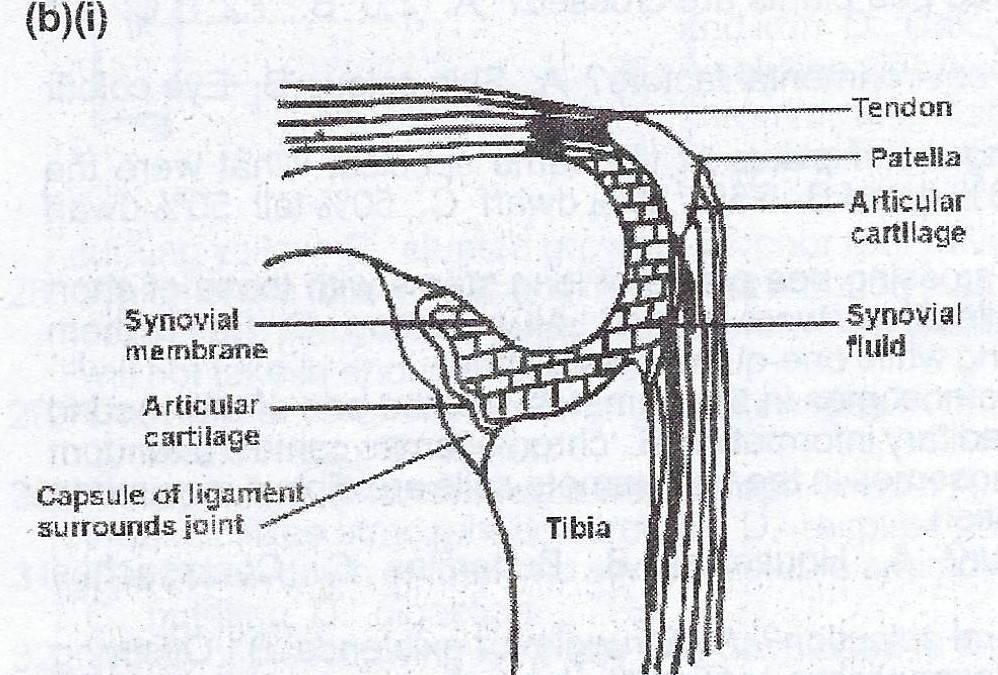
(b)(i) Make a labelled diagram, 8-10cm long, of a typical movable joint.
(iii) Explain how the structure of the joint adapts it to its function.
(ii) List three types of movable joints and mention one location in the mammalian body of each type.
(b)(i) Make a labelled diagram, 8-10cm long, of a typical movable joint.
(iii) Explain how the structure of the joint adapts it to its function.
Take Free Practice Test On 2026 JAMB UTME, Post UTME, WAEC SSCE, GCE, NECO SSCE
Correct Answer: Option n
Explanation:
(a)(i) A joint is a point/place, where two or more bones meet/articulate in the body
(ii) Types of Joints Location in the Body
- Ball and socket joint -Shoulder/hip
-Hinge joint -Elbow/knee/phalanges
-Sliding/gliding joint - Wrist/ankle/vertebrae
-Pivot/rotating joint - Neck
(ii) Adaptation of structure to function;
(a) There is the presence of cartilage to reduce friction between 2 bones in contact
(b) Ligament holds the bones together
(c) Synovial membrane secretes the synovial fluid
(d) Synovial fluid lubricates the joint thereby minimize shock and friction leading to easy movement of joint.
(a)(i) A joint is a point/place, where two or more bones meet/articulate in the body
(ii) Types of Joints Location in the Body
- Ball and socket joint -Shoulder/hip
-Hinge joint -Elbow/knee/phalanges
-Sliding/gliding joint - Wrist/ankle/vertebrae
-Pivot/rotating joint - Neck
(ii) Adaptation of structure to function;
(a) There is the presence of cartilage to reduce friction between 2 bones in contact
(b) Ligament holds the bones together
(c) Synovial membrane secretes the synovial fluid
(d) Synovial fluid lubricates the joint thereby minimize shock and friction leading to easy movement of joint.