(a) (i) Define asexual reproduction.
(ii) Name two types of asexual reproduction which occur in animals giving one example in each case.
(b) In a tabular form outline four differences between sexual and asexual reproduction.
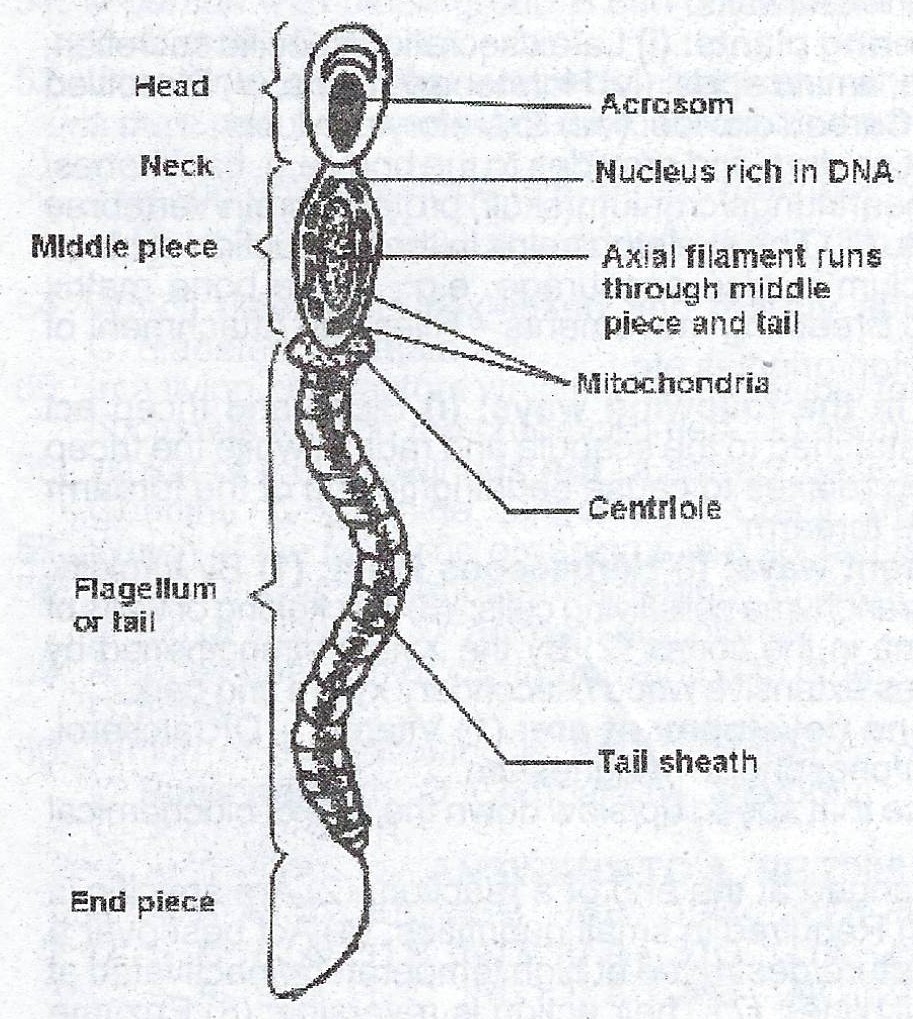
(c) Make a large, labelled diagram 8 - 10cm long of the human spermatozoon to show its structure.
(d) State one function each of any three organelles found in the spermatozoon.
(ii) Name two types of asexual reproduction which occur in animals giving one example in each case.
(b) In a tabular form outline four differences between sexual and asexual reproduction.
(c) Make a large, labelled diagram 8 - 10cm long of the human spermatozoon to show its structure.
(d) State one function each of any three organelles found in the spermatozoon.
Take Free Practice Test On 2026 JAMB UTME, Post UTME, WAEC SSCE, GCE, NECO SSCE
Correct Answer: Option n
Explanation:
(a)(i) Definition of asexual reproduction: Asexual reproduction is the production of a new individual from a parent / organism / order individual, without fertilization / gametes / change in chromosome number/genetic constitution; it involves, a single parent.
(ii) Types of asexual reproduction in animals Types Example;
(b) Differences between asexual and sexual reproduction Asexual reproduction
(c)
(d) Function of organelles;
Acrosome - contains enzymes / lytic agents that help to digest the cell membrane of the female ovum during fertilization.
Nucleus; contains haploid number of chromosomes / genetic materials / DNA
Mitochondria; contain respiratory enzymes / for respiration that provide energy / site for production of energy for locomotion/ movement.
(a)(i) Definition of asexual reproduction: Asexual reproduction is the production of a new individual from a parent / organism / order individual, without fertilization / gametes / change in chromosome number/genetic constitution; it involves, a single parent.
(ii) Types of asexual reproduction in animals Types Example;
| Types | Example |
| (1) Binary fission(2) Budding(3) Sporulation(4) Parthenogenesis(5) Schizogony(6) Fragmentation | Amoeba, ParameciumHydra/ObeliaAmoebaAphids, Honey beePlasmodium / MerozoidesPlanaria / Sponges / HydroidCoelenterate |
(b) Differences between asexual and sexual reproduction Asexual reproduction
| Asexual reproduction | Sexual reproduction |
| (1) One parent involved(2) No gametes formed(3) Meiosis not involved(4) No fertilization / fusion of gametes/ sex cell / no zygote formed(5) Offspring identical I. No genetic variation(6) Rapid / faster mode of reproduction(7) More individuals are produced | Two parents involvedGametes / sex cells formedmeiosis involvedFertilization / fusion of gametes / sex cells occur zygote formedOffspring vary genetically Slower mode of reproductionFewer individual are produced |
(c)
(d) Function of organelles;
Acrosome - contains enzymes / lytic agents that help to digest the cell membrane of the female ovum during fertilization.
Nucleus; contains haploid number of chromosomes / genetic materials / DNA
Mitochondria; contain respiratory enzymes / for respiration that provide energy / site for production of energy for locomotion/ movement.