(a)(i) Explain the term co-ordinance.
(ii) Calculate the number of individuals with co-dominant blood group.
(iii) What is the total number of individuals in the table that are able to donate blood to an accident victim with blood group B?
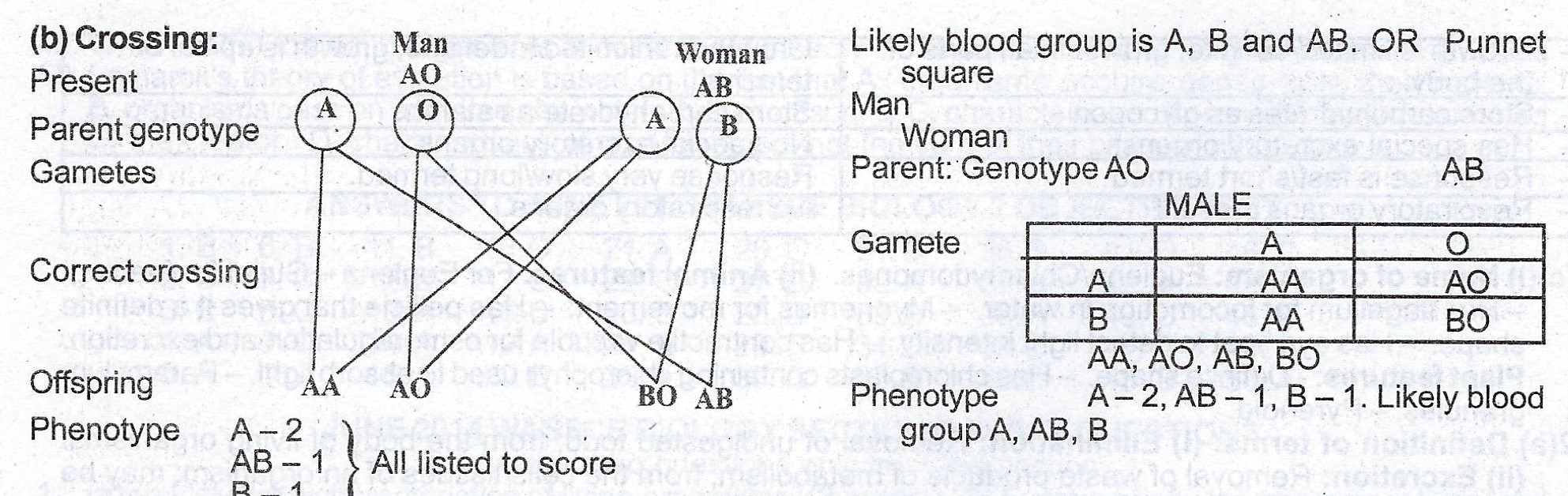
(b) A man whose blood group is heterozygous A is married to a
woman whose blood group is AB. With the aid of a genetic diagram, suggest the possible blood groups of their children.
A survey to determine blood groups was carried out on 250 people living in a community. The results are represented in the table below.
(ii) Calculate the number of individuals with co-dominant blood group.
(iii) What is the total number of individuals in the table that are able to donate blood to an accident victim with blood group B?
(b) A man whose blood group is heterozygous A is married to a
woman whose blood group is AB. With the aid of a genetic diagram, suggest the possible blood groups of their children.
A survey to determine blood groups was carried out on 250 people living in a community. The results are represented in the table below.
| Blood group | Percentage |
| A | 8.0 |
| B | 14.0 |
| AB | 32.8 |
| O | 45.2 |
Take Free Practice Test On 2026 JAMB UTME, Post UTME, WAEC SSCE, GCE, NECO SSCE
Correct Answer: Option n
Explanation:
(a)(i) Co-dominance: Co-dominance occurs when both the alleles in an heterozygous individual are fully expressed; that is both alleles exert their effects so that the hybrid has a phenotype; that is different from what the parents exhibit.
(ii) Calculation of individuals with co-dominant blood group: Mention of co-dominant blood group is AB. Evidence of calculation 32.8% of 250 OR 32.8/100 x 250 = 82 individuals/ people.
(iii) Total number of individuals that can donate blood to blood group B: The total number of individuals will be from groups B and 0.
—14% of the population is Blood group B 14% of 250 OR 14/100 x 250 = 35 individuals/people.
— 45.2% of the population is Blood group 0 45.2% of 250 OR 45.2/100 x 250 = 113 individuals/people.
— Total number of people = 113 of group 0+ 35 of group B = 148 Individuals/people can donate blood to the accident victim in B. OR The total number of individuals from (B and 0) blood group B and 0
— 14% + 45.2 = 59.2%.
— 59.2% of 250. 592/100 x 250 = 148 people/individuals.
(b)
(a)(i) Co-dominance: Co-dominance occurs when both the alleles in an heterozygous individual are fully expressed; that is both alleles exert their effects so that the hybrid has a phenotype; that is different from what the parents exhibit.
(ii) Calculation of individuals with co-dominant blood group: Mention of co-dominant blood group is AB. Evidence of calculation 32.8% of 250 OR 32.8/100 x 250 = 82 individuals/ people.
(iii) Total number of individuals that can donate blood to blood group B: The total number of individuals will be from groups B and 0.
—14% of the population is Blood group B 14% of 250 OR 14/100 x 250 = 35 individuals/people.
— 45.2% of the population is Blood group 0 45.2% of 250 OR 45.2/100 x 250 = 113 individuals/people.
— Total number of people = 113 of group 0+ 35 of group B = 148 Individuals/people can donate blood to the accident victim in B. OR The total number of individuals from (B and 0) blood group B and 0
— 14% + 45.2 = 59.2%.
— 59.2% of 250. 592/100 x 250 = 148 people/individuals.
(b)