Use the information below to answer questions (a)(i) and (a)(ii).
Hb Are presents normal haemoglobin,
HbS represents sickled haemoglobin.
a. A female heterozygote for sickle cell married a sickler. With the aid of a genetic diagram, determine the:
(i) possible genotypes of their offspring; [8 marks]
(ii) phenotypic ratio of the offspring. [2 marks]
b. Explain briefly the reason why a Rhesus negative woman married to a Rhesus positive man might lose her second pregnancy. [5 marks]
c. Name two examples of features in animals that support the theory of use and disuse of body parts as used by Lamarck. [2 marks]
d. List three structures in mammals that are vestigial. [3 marks]
Hb Are presents normal haemoglobin,
HbS represents sickled haemoglobin.
a. A female heterozygote for sickle cell married a sickler. With the aid of a genetic diagram, determine the:
(i) possible genotypes of their offspring; [8 marks]
(ii) phenotypic ratio of the offspring. [2 marks]
b. Explain briefly the reason why a Rhesus negative woman married to a Rhesus positive man might lose her second pregnancy. [5 marks]
c. Name two examples of features in animals that support the theory of use and disuse of body parts as used by Lamarck. [2 marks]
d. List three structures in mammals that are vestigial. [3 marks]
Take Free Practice Test On 2026 JAMB UTME, Post UTME, WAEC SSCE, GCE, NECO SSCE
Correct Answer: Option
Explanation:
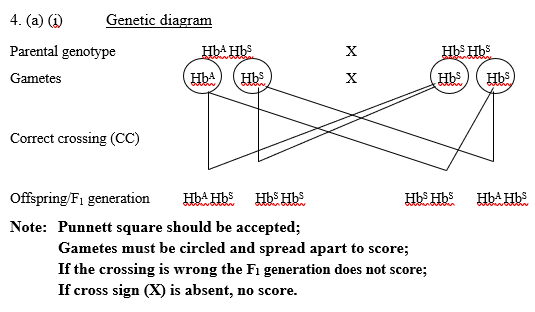
(ii) Phenotypic ratio
2:2 or 1:1/Ratio of sickler to non-sicklers.
b. Reasons why a rhesus negative woman married to a rhesus positive man might lose her second pregnancy
- Rhesus negative mother has no antigen on the surface of her Red Blood Cells/RBC;
- the husband has antigen on his RBC;
- during her first pregnancy, the child carries positive Rhesus factor;
- the Rhesus factor enters the mother’s blood stream;
- due to rupture of the placenta, blood seeps into the mother's blood;
- causing it to develop anti-Rhesus antibodies;
- causing agglutination in small proportion of foetal blood cells;
- in the second pregnancy, the child might be Rhesus positive;
- the child carrying Rhesus positive suffers massive destruction of red blood cells/erythroblastosis fetalis;
- which might result into miscarriage of the second child.
c. Examples of features in animals that support the theory of use and disuse of body parts as used by Lamarck
- long neck in Giraffe;
- smaller wings in Penguins;
- lost legs of snakes;
- long legs of Heron;
- webbed feet of ducks/frogs/geese.
d. Vestigial organs in mammals
- appendix in humans;
- pelvic and leg bones in whale;
- reduced coccyx in man/caudal vertebrae;
- pyramidalis nasi (extrinsic) muscle/muscles of the forehead;
- posterior auricular muscles to move the ear/pinna;
- erector muscle;
- nipples in males;
- sinuses;
- tonsils;
- wisdom teeth;
- hairs on the chest.
(ii) Phenotypic ratio
2:2 or 1:1/Ratio of sickler to non-sicklers.
b. Reasons why a rhesus negative woman married to a rhesus positive man might lose her second pregnancy
- Rhesus negative mother has no antigen on the surface of her Red Blood Cells/RBC;
- the husband has antigen on his RBC;
- during her first pregnancy, the child carries positive Rhesus factor;
- the Rhesus factor enters the mother’s blood stream;
- due to rupture of the placenta, blood seeps into the mother's blood;
- causing it to develop anti-Rhesus antibodies;
- causing agglutination in small proportion of foetal blood cells;
- in the second pregnancy, the child might be Rhesus positive;
- the child carrying Rhesus positive suffers massive destruction of red blood cells/erythroblastosis fetalis;
- which might result into miscarriage of the second child.
c. Examples of features in animals that support the theory of use and disuse of body parts as used by Lamarck
- long neck in Giraffe;
- smaller wings in Penguins;
- lost legs of snakes;
- long legs of Heron;
- webbed feet of ducks/frogs/geese.
d. Vestigial organs in mammals
- appendix in humans;
- pelvic and leg bones in whale;
- reduced coccyx in man/caudal vertebrae;
- pyramidalis nasi (extrinsic) muscle/muscles of the forehead;
- posterior auricular muscles to move the ear/pinna;
- erector muscle;
- nipples in males;
- sinuses;
- tonsils;
- wisdom teeth;
- hairs on the chest.