(a)(1) Define covalent bond.
(ii) Give two properties of covalent compounds
(ii) With the aid of a diagram, show how ammonia molecule is formed
(iv) Illustrate with a diagram the formation of ammonium ion?
(v) What type of bond(s) exist(s) in I. ammonia, H. ammonium ion? (\(_1\)H\(_7\)N)
(b)(i) Write three subatomic particles with their corresponding relative masses. CH\(_2\)OH
(ii) Name the possible states in which water can exist.
(c) (i) State Graham's law of diffusion
(ii) Arrange the following gases, He, CH\(_4\) and N\(_2\) in order of increasing rates of diffusion. Give a reason for the order. [ H = 1, He = 4, C = 12, N = 14 ]
(d) Draw the structures of the following compounds:
(i) 2,3-dimethylbutane;
(ii) 1,4-dibromocyclohexane.
(ii) Give two properties of covalent compounds
(ii) With the aid of a diagram, show how ammonia molecule is formed
(iv) Illustrate with a diagram the formation of ammonium ion?
(v) What type of bond(s) exist(s) in I. ammonia, H. ammonium ion? (\(_1\)H\(_7\)N)
(b)(i) Write three subatomic particles with their corresponding relative masses. CH\(_2\)OH
(ii) Name the possible states in which water can exist.
(c) (i) State Graham's law of diffusion
(ii) Arrange the following gases, He, CH\(_4\) and N\(_2\) in order of increasing rates of diffusion. Give a reason for the order. [ H = 1, He = 4, C = 12, N = 14 ]
(d) Draw the structures of the following compounds:
(i) 2,3-dimethylbutane;
(ii) 1,4-dibromocyclohexane.
Take Free Practice Test On 2026 JAMB UTME, Post UTME, WAEC SSCE, GCE, NECO SSCE
Correct Answer: Option n
Explanation:
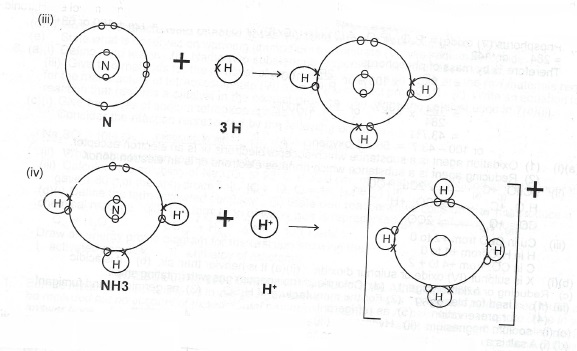
(a)(i) Covalent bond is a bond between two atoms in which each of the atoms contribute to the shared pair of electrons.
(ii) (a) Non-conductors of electricity (b) Insoluble in water/soluble in non-polar solvents. (c) Have low melting or boiling point.
(v) (a) covalent bond (b) covalent bond dative or coordinate covalent bond
(b)
(c)(i) Graham's law of diffusion states that a constant temperature and pressure, the rate of diffusion of a gas is inversely proportional to the square root of its vapour density or molecular mass.
(ii) N\(_2\), CH\(_4\), He : the smaller the molecular mass the faster the rate at which the gas diffuses or the larger the molar mass the slower the rate at which the gas diffuses.
(d)
(a)(i) Covalent bond is a bond between two atoms in which each of the atoms contribute to the shared pair of electrons.
(ii) (a) Non-conductors of electricity (b) Insoluble in water/soluble in non-polar solvents. (c) Have low melting or boiling point.
(v) (a) covalent bond (b) covalent bond dative or coordinate covalent bond
(b)
| Particles | Relative Masses Proton |
| Proton | 1 |
| Neutron | 1 |
| Electron | 1 |
| 1840 |
(c)(i) Graham's law of diffusion states that a constant temperature and pressure, the rate of diffusion of a gas is inversely proportional to the square root of its vapour density or molecular mass.
(ii) N\(_2\), CH\(_4\), He : the smaller the molecular mass the faster the rate at which the gas diffuses or the larger the molar mass the slower the rate at which the gas diffuses.
(d)