(a)(i) Draw the structure of the sixth member of the alkenes.
(ii) Calculate the relative molecular mass of the sixth member of the alkene.
(iii) State one difference between cracking and reforming in the petroleum industry. [H = 1, C = 12]
(b)(i) Define the term enthalpy of neutralization.
(ii) Describe briefly how the enthalpy of neutralization of the reaction of dilute hydrochloric acid and aqueous potassium hydroxide could be determined.
(c) An electrochemical cell is constructed with copper and silver electrodes.
(i) State which of the electrodes will be the: 1. anode; II. cathode.
(ii) Give the reason for your answer in 3(c)(i).
(iii) State the type of reaction occurring at each electrode.
(iv) Write a balanced equation for the overall cell reaction.
(d)(i) Name the compound formed when iron is exposed to moist air for a long time.
(ii) Write a balanced chemical equation for the reaction in 3(d)(i).
(iii) Name one ore of iron.
(ii) Calculate the relative molecular mass of the sixth member of the alkene.
(iii) State one difference between cracking and reforming in the petroleum industry. [H = 1, C = 12]
(b)(i) Define the term enthalpy of neutralization.
(ii) Describe briefly how the enthalpy of neutralization of the reaction of dilute hydrochloric acid and aqueous potassium hydroxide could be determined.
(c) An electrochemical cell is constructed with copper and silver electrodes.
(i) State which of the electrodes will be the: 1. anode; II. cathode.
(ii) Give the reason for your answer in 3(c)(i).
(iii) State the type of reaction occurring at each electrode.
(iv) Write a balanced equation for the overall cell reaction.
(d)(i) Name the compound formed when iron is exposed to moist air for a long time.
(ii) Write a balanced chemical equation for the reaction in 3(d)(i).
(iii) Name one ore of iron.
Take Free Practice Test On 2026 JAMB UTME, Post UTME, WAEC SSCE, GCE, NECO SSCE
Correct Answer: Option
Explanation:
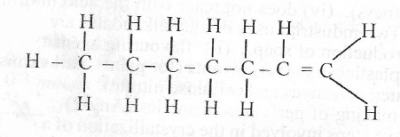
(a)(i) Structure of the sixth member of the alkenes: C\(_n\)H\(_{2n}\); n = 7, C\(_7\)H\(_{2 \times 7}\) = C\(_7\)H\(_14\)
(Double can be positioned within any of the carbon chain)
(ii) Relative molecular mass of the sixth member of alkene
(C\(_7\)H\(_14\) \(\begin {bmatrix} C & = 12 \\ H & = 1 \end{bmatrix}\)
(C\(_7\)H\(_14\) = (12 x 7) + (1 x 14)
= (12 x 7) + (1 x 14)
= 84 + 14
= 98 (no units)
(iii) One differences between cracking and reforming in the petroleum indutry:
CRACKING
Involves breaking large molecules of petroleumfractions into smaller molecules
Usect to improve the quantity of petrol.
Can be achieved thermally or catalytically
REFORMING
Involves re-arrangement of atoms in molecules of petroleum fractio'n to obtain branched and cyclic hydrocarbons
Usect to improve the quality of petrol.
Occurs in presence of a catalyst
Occurs in presence of a catalyst
(b)(i) Enthalpy of neuttalization is the beat evolved when an acid reacts with a base to form one mole of water or when one mole of OH\(^{+}\) from an acid reacts with one mole of OH\(^{-}\) from a base to form one mole of water.
(ii) Determination of enthalpy of neutralization of the reaction of dilute hydrochloric acid and aqueous potassium hydroxide
HCI\(_{(aq)}\)+ KOH\(_{(aq)}\) -> KC1 + H\(_{2}\)O
Equimolar solutions of hydrochloric acid and potassium hydroxide are prepared sepa'rately. A known volume of the acid is placed in a calorimeter/polystyrene beaker and the temperature recorded.
The same volume of the potassium hydroxide solution at the same temperature is poured into the calorimeter and the mixture stirred gently. The maximum temperature of the mixture is recorded.
Heat lost in the reaction = heat gained by the solution formed
OR \(\bigtriangleup\) H neutralization = mass of solution x specific heat capacity of water x change in temperature.
(c) An electrochemical cell connected with copper and silver electrodes. (i) A node : copper electrode
(ii) Cathode : silver electrode reasons in 3(c)(i)
(iii) Silver has a more positive Standard electrode potential than copper. Copper is more electropositive than silver or copper is higher in the electrochemical series
(iv) Type of reaction occuring at each electrode.
Anode : oxidation (occurs at the copper electrode).
Cathode : reduction (occurs at the siliver electrode).
(v) Balanced chemical equation for the overall cell reaction.
Cu\(_s\) + 2Ag\(^+\) \(\to\) CU\(^{2+}_{(aq)}\) + 2Ag\(_(s)\)
(d) Compound formed when iron is exposed to moist air for a long time; (i) Hydrated Iron(III) oxide. (ii) Balanced chemical equation for the reaction in 3(d)(i).
4Fe\(_s\) + 3O\(_{2(g)}\) + 2 x H\(_2\)O\(_l\) \(\to\) 2Fe\(_2\)O\(_3\).XH\(_2\)O
where X is 1
4Fe\(_s\) + 3O\(_{2(g)}\) + 2H\(_2\)O\(_l\) \(\to\) 2Fe\(_2\)O\(_3\).H\(_2\)O
(iii) One ore of iron: haematite, magnetite, siderite/spathic iron ore, limonite, iron pyrites
(a)(i) Structure of the sixth member of the alkenes: C\(_n\)H\(_{2n}\); n = 7, C\(_7\)H\(_{2 \times 7}\) = C\(_7\)H\(_14\)
(Double can be positioned within any of the carbon chain)
(ii) Relative molecular mass of the sixth member of alkene
(C\(_7\)H\(_14\) \(\begin {bmatrix} C & = 12 \\ H & = 1 \end{bmatrix}\)
(C\(_7\)H\(_14\) = (12 x 7) + (1 x 14)
= (12 x 7) + (1 x 14)
= 84 + 14
= 98 (no units)
(iii) One differences between cracking and reforming in the petroleum indutry:
CRACKING
Involves breaking large molecules of petroleumfractions into smaller molecules
Usect to improve the quantity of petrol.
Can be achieved thermally or catalytically
REFORMING
Involves re-arrangement of atoms in molecules of petroleum fractio'n to obtain branched and cyclic hydrocarbons
Usect to improve the quality of petrol.
Occurs in presence of a catalyst
Occurs in presence of a catalyst
(b)(i) Enthalpy of neuttalization is the beat evolved when an acid reacts with a base to form one mole of water or when one mole of OH\(^{+}\) from an acid reacts with one mole of OH\(^{-}\) from a base to form one mole of water.
(ii) Determination of enthalpy of neutralization of the reaction of dilute hydrochloric acid and aqueous potassium hydroxide
HCI\(_{(aq)}\)+ KOH\(_{(aq)}\) -> KC1 + H\(_{2}\)O
Equimolar solutions of hydrochloric acid and potassium hydroxide are prepared sepa'rately. A known volume of the acid is placed in a calorimeter/polystyrene beaker and the temperature recorded.
The same volume of the potassium hydroxide solution at the same temperature is poured into the calorimeter and the mixture stirred gently. The maximum temperature of the mixture is recorded.
Heat lost in the reaction = heat gained by the solution formed
OR \(\bigtriangleup\) H neutralization = mass of solution x specific heat capacity of water x change in temperature.
(c) An electrochemical cell connected with copper and silver electrodes. (i) A node : copper electrode
(ii) Cathode : silver electrode reasons in 3(c)(i)
(iii) Silver has a more positive Standard electrode potential than copper. Copper is more electropositive than silver or copper is higher in the electrochemical series
(iv) Type of reaction occuring at each electrode.
Anode : oxidation (occurs at the copper electrode).
Cathode : reduction (occurs at the siliver electrode).
(v) Balanced chemical equation for the overall cell reaction.
Cu\(_s\) + 2Ag\(^+\) \(\to\) CU\(^{2+}_{(aq)}\) + 2Ag\(_(s)\)
(d) Compound formed when iron is exposed to moist air for a long time; (i) Hydrated Iron(III) oxide. (ii) Balanced chemical equation for the reaction in 3(d)(i).
4Fe\(_s\) + 3O\(_{2(g)}\) + 2 x H\(_2\)O\(_l\) \(\to\) 2Fe\(_2\)O\(_3\).XH\(_2\)O
where X is 1
4Fe\(_s\) + 3O\(_{2(g)}\) + 2H\(_2\)O\(_l\) \(\to\) 2Fe\(_2\)O\(_3\).H\(_2\)O
(iii) One ore of iron: haematite, magnetite, siderite/spathic iron ore, limonite, iron pyrites