(a) Using the same axes, sketch the curves \(y = 6 - x - x^{2}\) and \(y = 3x^{2} - 2x + 3\).
(b) Find the x- coordinates of the points of intersection of the two curves in (a).
(c) Calculatethe area of the finite region bounded by the two curves in (a).
(b) Find the x- coordinates of the points of intersection of the two curves in (a).
(c) Calculatethe area of the finite region bounded by the two curves in (a).
Take Free Practice Test On 2026 JAMB UTME, Post UTME, WAEC SSCE, GCE, NECO SSCE
Correct Answer: Option n
Explanation:
(a) \(y = 6 - x - x^{2}\)
When x = 0, y = 6.
When y = 0, \(x^{2} + x - 6 = 0\)
\(x^{2} + 3x - 2x - 6 = 0 \implies x(x + 3) - 2(x + 3) = 0\)
\(x = -3 ; x = 2\)
Graph passes through (0, 6), (-3, 0) (2, 0).
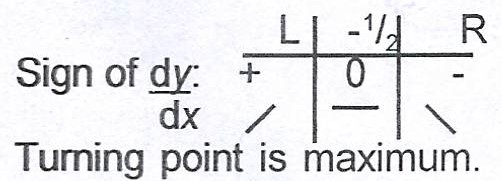
Turning point : \(\frac{\mathrm d y}{\mathrm d x} = - 1 - 2x\)
\(-1 - 2x = 0 \implies x = \frac{-1}{2}\)
When \(x = \frac{-1}{2}\), \(y = 6 - (-\frac{1}{2}) - (\frac{-1}{2})^{2} = 6\frac{1}{4}\).
Turning point : \((-\frac{1}{2}, 6\frac{1}{4})\).
\(y = 3x^{2} - 2x + 3\)
When x = 0, y = 3.
\(b^{2} - 4ac = (-2)^{2} - 4(3)(3) = 4 - 36 < 0\)
Graph does not cut x - axis.
\(\frac{\mathrm d y}{\mathrm d x} = 6x - 2\)
At turning point, \(6x - 2 = 0 \implies x = \frac{2}{6} = \frac{1}{3}\)
When \(x = \frac{1}{3}, y = 3(\frac{1}{3})^{2} - 2(\frac{1}{3}) + 3 = 2\frac{2}{3}\)
Turning point : \((\frac{1}{3}, 2\frac{2}{3})\).
(b) For the x- coordinates, we use the equation.
\(3x^{2} - 2x + 3 = 6 - x - x^{2}\)
\(4x^{2} - x - 3 = 0 \implies 4x^{2} - 4x + 3x - 3 = 0\)
\(4x(x - 1) + 3(x - 1) = 0 \implies (4x + 3)(x - 1) = 0\)
\(x = -\frac{3}{4} ; 1\)
(c) Area of shaded portion :
\(\int_{-\frac{3}{4}} ^{1} [(6 - x - x^{2}) - (3x^{2} - 2x + 3)] \mathrm {d} x\)
= \(\int_{-\frac{3}{4}} ^{1} (3 + x - 4x^{2}) \mathrm {d} x\)
= \([3x + \frac{x^{2}}{2} - \frac{4}{3}x^{3}]|_{-\frac{3}{4}} ^{1}\)
= \((3(1) + \frac{1}{2} - \frac{4}{3}) - (3(-\frac{3}{4}) + \frac{(\frac{-3}{4})^{2}}{2} - \frac{4}{3} (-\frac{3}{4})^{3}\)
= \(\frac{13}{6} - (-\frac{45}{32})\)
= \(\frac{343}{96} sq. units\)
(a) \(y = 6 - x - x^{2}\)
When x = 0, y = 6.
When y = 0, \(x^{2} + x - 6 = 0\)
\(x^{2} + 3x - 2x - 6 = 0 \implies x(x + 3) - 2(x + 3) = 0\)
\(x = -3 ; x = 2\)
Graph passes through (0, 6), (-3, 0) (2, 0).
Turning point : \(\frac{\mathrm d y}{\mathrm d x} = - 1 - 2x\)
\(-1 - 2x = 0 \implies x = \frac{-1}{2}\)
When \(x = \frac{-1}{2}\), \(y = 6 - (-\frac{1}{2}) - (\frac{-1}{2})^{2} = 6\frac{1}{4}\).
Turning point : \((-\frac{1}{2}, 6\frac{1}{4})\).
\(y = 3x^{2} - 2x + 3\)
When x = 0, y = 3.
\(b^{2} - 4ac = (-2)^{2} - 4(3)(3) = 4 - 36 < 0\)
Graph does not cut x - axis.
\(\frac{\mathrm d y}{\mathrm d x} = 6x - 2\)
At turning point, \(6x - 2 = 0 \implies x = \frac{2}{6} = \frac{1}{3}\)
When \(x = \frac{1}{3}, y = 3(\frac{1}{3})^{2} - 2(\frac{1}{3}) + 3 = 2\frac{2}{3}\)
Turning point : \((\frac{1}{3}, 2\frac{2}{3})\).
(b) For the x- coordinates, we use the equation.
\(3x^{2} - 2x + 3 = 6 - x - x^{2}\)
\(4x^{2} - x - 3 = 0 \implies 4x^{2} - 4x + 3x - 3 = 0\)
\(4x(x - 1) + 3(x - 1) = 0 \implies (4x + 3)(x - 1) = 0\)
\(x = -\frac{3}{4} ; 1\)
(c) Area of shaded portion :
\(\int_{-\frac{3}{4}} ^{1} [(6 - x - x^{2}) - (3x^{2} - 2x + 3)] \mathrm {d} x\)
= \(\int_{-\frac{3}{4}} ^{1} (3 + x - 4x^{2}) \mathrm {d} x\)
= \([3x + \frac{x^{2}}{2} - \frac{4}{3}x^{3}]|_{-\frac{3}{4}} ^{1}\)
= \((3(1) + \frac{1}{2} - \frac{4}{3}) - (3(-\frac{3}{4}) + \frac{(\frac{-3}{4})^{2}}{2} - \frac{4}{3} (-\frac{3}{4})^{3}\)
= \(\frac{13}{6} - (-\frac{45}{32})\)
= \(\frac{343}{96} sq. units\)