With the aid of diagrams, describe the appearance and mode of formation of any two of the following landforms: \
(a) Delta; (b) block mountain; (c) rock pedestal.
(a) Delta; (b) block mountain; (c) rock pedestal.
Take Free Practice Test On 2026 JAMB UTME, Post UTME, WAEC SSCE, GCE, NECO SSCE
Correct Answer: Option n
Explanation:
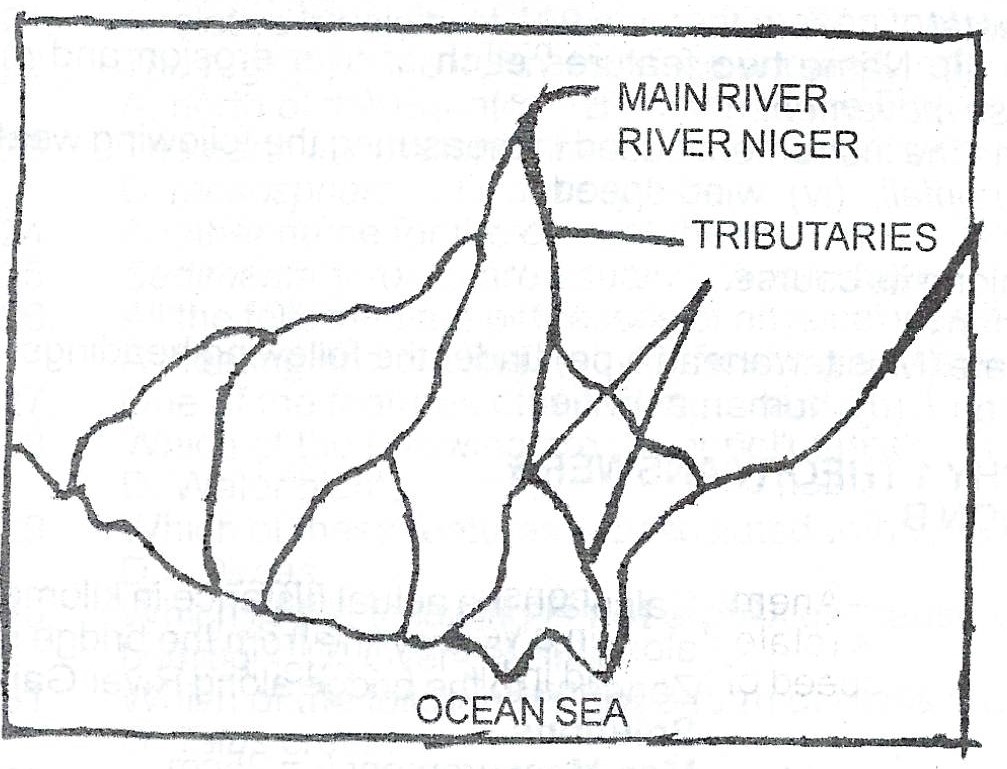
(a) DELTA
Appearance
— Fan - shaped
— Found usually in the mouth rivers
— Characterized by distributaries
— Birds foot, e.g Missisippi delta
— Estuarine de e.g Vistula
— Arcuate Delta, e.g Niger delta
— Cuspate type, e.g Ebro of Spain.
Mode of Formation
— Formed by the deposition of loads carried from th upper part of the river.
— Deposition takes place at the mouth of the river.
— Absence of strong current leads to the blocking c the flow of the river.
— Causing division of the main river into several distributaries.
— The distributaries extend into the sea to form a sheltered coast with shallow water.
— River flows through the distributaries into the sea
Appearance
— Usually flat topped
— Steep sided
— Could be tilted
— Associated with faults
— Associated with rift valleys
— Examples:- Vosges, Black Forest, Ruwenzori.
Formation
— Results from lateral or vertical earth movements
— Causing faulting.
— Faulting may result from tensional / compressional forces.
— Tensional Forces pull crystal blocks apart
— Leaving the middle block to form block mountain
— Compressional forces push the outside blocks up to form block mountains.
Appearance
— Consists of horizontal layers of hard and soft rocks Like a pillar in structure
— Narrow at the base and broader at the top
— May range from 10 -15 metres high
— Flat / dome - shaped
— Irregular surface.
Formation
— Alternate bands of soft and hard horizontal rocks lying at right angles to the prevailing wind.
— Formed by wind abrasion
— Abrasive action attacks alternate horizontal layers of hard and soft rocks.
— Soft rocks are removed (eroded) faster than the hard rocks.
— Abrasion is stronger at ground level, resulting in serious under-cutting.
— Irregular-shaped feature called rock pedestal is produced.
— Found in deserts e.g Sahara Desert.
(a) DELTA
Appearance
— Fan - shaped
— Found usually in the mouth rivers
— Characterized by distributaries
— Birds foot, e.g Missisippi delta
— Estuarine de e.g Vistula
— Arcuate Delta, e.g Niger delta
— Cuspate type, e.g Ebro of Spain.
Mode of Formation
— Formed by the deposition of loads carried from th upper part of the river.
— Deposition takes place at the mouth of the river.
— Absence of strong current leads to the blocking c the flow of the river.
— Causing division of the main river into several distributaries.
— The distributaries extend into the sea to form a sheltered coast with shallow water.
— River flows through the distributaries into the sea
Appearance
— Usually flat topped
— Steep sided
— Could be tilted
— Associated with faults
— Associated with rift valleys
— Examples:- Vosges, Black Forest, Ruwenzori.
Formation
— Results from lateral or vertical earth movements
— Causing faulting.
— Faulting may result from tensional / compressional forces.
— Tensional Forces pull crystal blocks apart
— Leaving the middle block to form block mountain
— Compressional forces push the outside blocks up to form block mountains.
Appearance
— Consists of horizontal layers of hard and soft rocks Like a pillar in structure
— Narrow at the base and broader at the top
— May range from 10 -15 metres high
— Flat / dome - shaped
— Irregular surface.
Formation
— Alternate bands of soft and hard horizontal rocks lying at right angles to the prevailing wind.
— Formed by wind abrasion
— Abrasive action attacks alternate horizontal layers of hard and soft rocks.
— Soft rocks are removed (eroded) faster than the hard rocks.
— Abrasion is stronger at ground level, resulting in serious under-cutting.
— Irregular-shaped feature called rock pedestal is produced.
— Found in deserts e.g Sahara Desert.