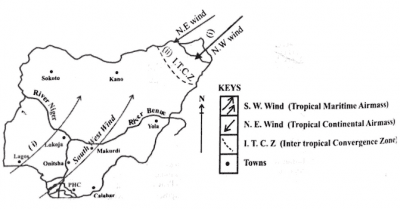
(a) Draw an outline map of Nigeria. On the map. show and name:
(i) the position of Tropical Maritime air mass (S.W. Winds) in July:
(ii) the position of Inter Tropical Convergence Zone (I. T. C. Z) in July;
(iii) the relative position of Tropical Continental air mass (N. F. Winds) in July:
(iv) three towns located in (a.)(i) above.
(b) State four characteristics of the wet season in Nigeria.
(c) List two cash crops grown during the wet season in Nigeria.
(i) the position of Tropical Maritime air mass (S.W. Winds) in July:
(ii) the position of Inter Tropical Convergence Zone (I. T. C. Z) in July;
(iii) the relative position of Tropical Continental air mass (N. F. Winds) in July:
(iv) three towns located in (a.)(i) above.
(b) State four characteristics of the wet season in Nigeria.
(c) List two cash crops grown during the wet season in Nigeria.
Take Free Practice Test On 2026 JAMB UTME, Post UTME, WAEC SSCE, GCE, NECO SSCE
Correct Answer: Option
Explanation:
(b) Characteristics of the wet season in Nigeria: (i) The prevailing wind is the Tropical Maritime Airmass.
(ii) Temperatures high. 27°C to 33°C. (iii) There is high pressure in the south due to low km pressure in the North due to high temperature.
(v) Heavy rainfall occurs in Nigeria during the wet season (over 1500mm).
(iv) The North experiences single maximum of rainfall. (vii) The South experiences double maxima of rainfall.
(viii) Rainfall duration decreases from the South towards the North.
(ix) Rainfall amount decreases from the South towards the North.
(x) Rainy season starts in April and ends in October.
(xi) Relative humidity of 80% to 100% decreases Northwards.
(xii) Short dry season in August in the South - (August Break) (xiii) Heavy rainfall in My line September in the South.
(xiv) Heavy rainfall in the North in July.
(xv) Rain accompanied by thunderstorm and line squalls. (xvi) Diurnal range of temperature increases Northwards (2°C— 1°C).
(c) Cash crops grown during the wet season in Nigeria: (i) Maize. (ii) Rice. (iii) Oil palm. (iv) Coffee.
(v) Kola nuts. (vi) Cocoa. (vii) Cashew nuts. (viii) Ginger. (ix) Cotton. (x) Groundnuts.
(b) Characteristics of the wet season in Nigeria: (i) The prevailing wind is the Tropical Maritime Airmass.
(ii) Temperatures high. 27°C to 33°C. (iii) There is high pressure in the south due to low km pressure in the North due to high temperature.
(v) Heavy rainfall occurs in Nigeria during the wet season (over 1500mm).
(iv) The North experiences single maximum of rainfall. (vii) The South experiences double maxima of rainfall.
(viii) Rainfall duration decreases from the South towards the North.
(ix) Rainfall amount decreases from the South towards the North.
(x) Rainy season starts in April and ends in October.
(xi) Relative humidity of 80% to 100% decreases Northwards.
(xii) Short dry season in August in the South - (August Break) (xiii) Heavy rainfall in My line September in the South.
(xiv) Heavy rainfall in the North in July.
(xv) Rain accompanied by thunderstorm and line squalls. (xvi) Diurnal range of temperature increases Northwards (2°C— 1°C).
(c) Cash crops grown during the wet season in Nigeria: (i) Maize. (ii) Rice. (iii) Oil palm. (iv) Coffee.
(v) Kola nuts. (vi) Cocoa. (vii) Cashew nuts. (viii) Ginger. (ix) Cotton. (x) Groundnuts.