(a) Copy and complete the following table of values for the relation \(y = x^{2} - 2x - 5\)
(b) Draw the graph of the relation \(y = x^{2} - 2x - 5\); using a scale of 2 cm to 1 unit on the x- axis, and 2 cm to 2 units on the y- axis.
(c) Using the same axes, draw the graph of \(y = 2x + 3\).
(d) Obtain in the form \(ax^{2} + bx + c = 0\) where a, b and c are integers, the equation which is satisfied by the x- coordinate of the points of intersection of the two graphs.
(e) From your graphs, determine the roots of the equation obtained in (d) above.
| x | -3 | -2 | -1 | 0 | 1 | 2 | 3 | 4 | 5 |
| y | -2 | -6 | -2 | 3 | 10 |
(b) Draw the graph of the relation \(y = x^{2} - 2x - 5\); using a scale of 2 cm to 1 unit on the x- axis, and 2 cm to 2 units on the y- axis.
(c) Using the same axes, draw the graph of \(y = 2x + 3\).
(d) Obtain in the form \(ax^{2} + bx + c = 0\) where a, b and c are integers, the equation which is satisfied by the x- coordinate of the points of intersection of the two graphs.
(e) From your graphs, determine the roots of the equation obtained in (d) above.
Take Free Practice Test On 2026 JAMB UTME, Post UTME, WAEC SSCE, GCE, NECO SSCE
Correct Answer: Option n
Explanation:
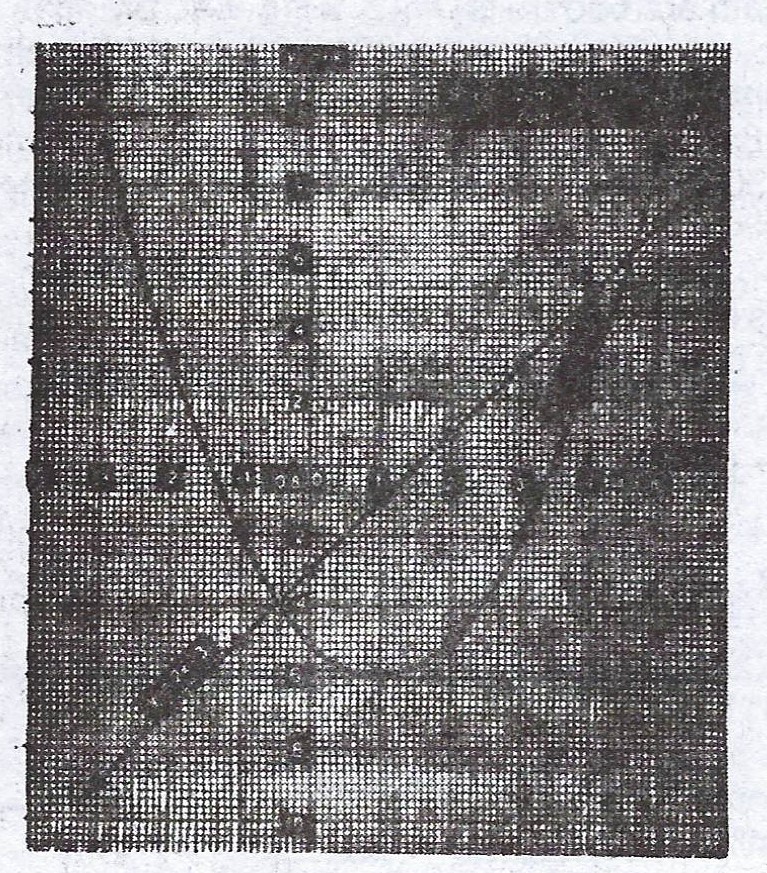
(a)
(b)
(c)
(d) \(x^{2} - 2x - 5 = 2x - 3\)
\(x^{2} - 2x - 2x - 5 + 3 = 0\)
\(x^{2} - 4x - 2 = 0\)
(e) x = -0.8 or 4.3
(a)
| x | -3 | -2 | -1 | 0 | 1 | 2 | 3 | 4 | 5 |
| \(x^{2}\) | 9 | 4 | 1 | 0 | 1 | 4 | 9 | 16 | 25 |
| \(-2x\) | 6 | 4 | 2 | 0 | -2 | -4 | -6 | -8 | -10 |
| -5 | -5 | -5 | -5 | -5 | -5 | -5 | -5 | -5 | -5 |
| y | 10 | 3 | -2 | -5 | -6 | -5 | -2 | 3 | 10 |
(b)
(c)
| x | -3 | -2 | -1 | 0 | 1 | 2 | 3 | 4 | 5 |
| \(2x\) | -6 | -4 | -2 | 0 | 2 | 4 | 6 | 8 | 10 |
| -3 | -3 | -3 | -3 | -3 | -3 | -3 | -3 | -3 | -3 |
| y | -9 | -7 | -5 | -3 | -1 | 1 | 3 | 5 | 7 |
(d) \(x^{2} - 2x - 5 = 2x - 3\)
\(x^{2} - 2x - 2x - 5 + 3 = 0\)
\(x^{2} - 4x - 2 = 0\)
(e) x = -0.8 or 4.3