(a) (i) Using a scale of 2 cm to 1 unit on both axes, on the same graph sheet, draw the graphs of \(y - \frac{3x}{4} = 3\) and \(y + 2x = 6\).
(ii) From your graph, find the coordinates of the point of intersection of the two graphs.
(iii) Show, on the graph sheet, the region satisfied by the inequality \(y - \frac{3}{4}x \geq 3\).
(b) Given that \(x^{2} + bx + 18\) is factorized as \((x + 2)(x + c)\). Find the values of c and b.
(ii) From your graph, find the coordinates of the point of intersection of the two graphs.
(iii) Show, on the graph sheet, the region satisfied by the inequality \(y - \frac{3}{4}x \geq 3\).
(b) Given that \(x^{2} + bx + 18\) is factorized as \((x + 2)(x + c)\). Find the values of c and b.
Take Free Practice Test On 2026 JAMB UTME, Post UTME, WAEC SSCE, GCE, NECO SSCE
Correct Answer: Option n
Explanation:
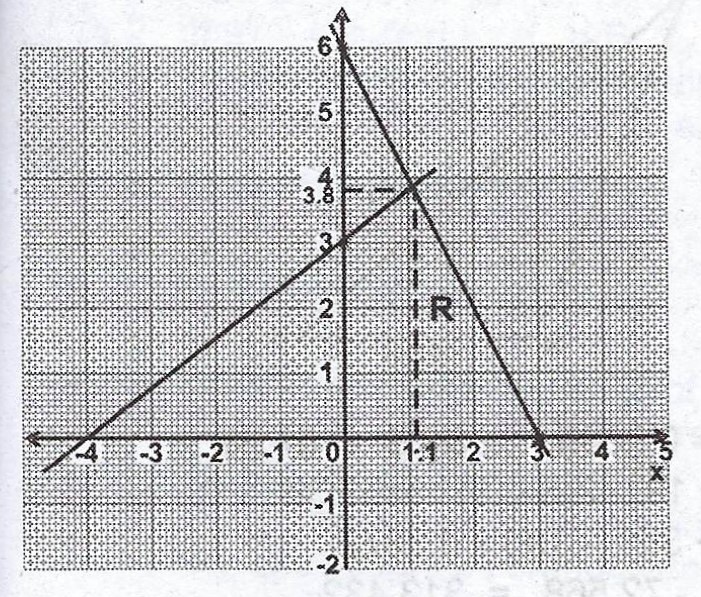
(a)(i) R is the required region.
(iii) Coordinates of the point of intersection of the two graphs = (1.1, 3.8)
(b) Assuming \(y - \frac{3x}{4} = 3\)
If x = 0, \(y - \frac{3}{4}(0) = 3 \implies y = 3\)
If y = 0, \(0 - \frac{3}{4}x = 3 \implies -3x = 12 ; x = - 4\)
Assuming \(y + 2x = 6\)
If x = 0, \(y + 2(0) = 6 \implies y = 6\)
If y = 0, \(0 + 2x = 6 \implies 2x = 6 ; x = 3\)
(b) \((x + 2)(x + c) = x^{2} + 2x + cx + 2c\)
\(x^{2} + (2 + c)x + 2c = x^{2} + bx + 18\)
\( 2c = 18 ; c = 9\)
\(b = 2 + c = 2 + 9 = 11\)
(b, c) = (11, 9).
(a)(i) R is the required region.
(iii) Coordinates of the point of intersection of the two graphs = (1.1, 3.8)
(b) Assuming \(y - \frac{3x}{4} = 3\)
If x = 0, \(y - \frac{3}{4}(0) = 3 \implies y = 3\)
If y = 0, \(0 - \frac{3}{4}x = 3 \implies -3x = 12 ; x = - 4\)
| x | 0 | -4 |
| y | 3 | 0 |
Assuming \(y + 2x = 6\)
If x = 0, \(y + 2(0) = 6 \implies y = 6\)
If y = 0, \(0 + 2x = 6 \implies 2x = 6 ; x = 3\)
| x | 0 | 3 |
| y | 6 | 0 |
(b) \((x + 2)(x + c) = x^{2} + 2x + cx + 2c\)
\(x^{2} + (2 + c)x + 2c = x^{2} + bx + 18\)
\( 2c = 18 ; c = 9\)
\(b = 2 + c = 2 + 9 = 11\)
(b, c) = (11, 9).