(a) If (3 - x), 6, (7 - 5x) are consecutive terms of a geometric progression (GP) with constant ratio r > 0, find the :
(i) values of x ; (ii) constant ratio.
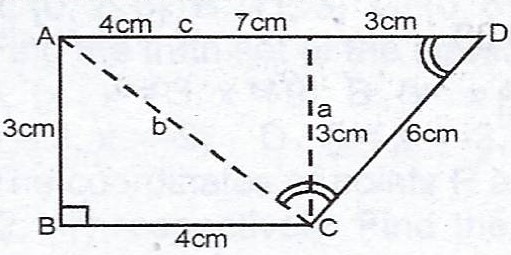
(b) In the diagram, |AB| = 3 cm, |BC| = 4 cm, |CD| = 6 cm and |DA| = 7 cm. Calculate <ADC, correct to the nearest degree.
(i) values of x ; (ii) constant ratio.
(b) In the diagram, |AB| = 3 cm, |BC| = 4 cm, |CD| = 6 cm and |DA| = 7 cm. Calculate <ADC, correct to the nearest degree.
Take Free Practice Test On 2026 JAMB UTME, Post UTME, WAEC SSCE, GCE, NECO SSCE
Correct Answer: Option n
Explanation:
(a) (i) (3 - x), 6, (7 - 5x).
First term = a = (3 - x)
common ratio = \(\frac{6}{3 - x} = \frac{7 - 5x}{6}\)
\(36 = (3 - x)(7 - 5x)\)
\(36 = 21 - 15x - 7x + 5x^{2}\)
\(36 = 21 - 22x + 5x^{2}\)
\(5x^{2} - 22x + 21 - 36 = 0\)
\(5x^{2} - 22x - 15 = 0\)
\(5x^{2} - 25x + 3x - 15 = 0 \implies 5x(x - 5) + 3(x - 5) = 0\)
\((x - 5)(5x + 3) = 0\)
\(x = -\frac{3}{5} \text{ or = } 5\)
(ii) Constant ratio = \(\frac{6}{3 - x} = \frac{7 - 5x}{6}\)
Using x = 5,
\(r = \frac{7 - 5(5)}{6} = \frac{-18}{6}\)
= \(-3\)
(b) Considering \(\Delta\) AOC
\(b^{2} = 4^{2} + 3^{2}\)
\(b^{2} = 16 + 9 = 25\)
\(b = \sqrt{25} = 5 cm\)
Considering \(\Delta\) ACD,
Using cosine rule,
\(\cos D = \frac{a^{2} + b^{2} - c^{2}}{2ab} = \frac{a^{2} + c^{2} - b^{2}}{2ac}\)
= \(\frac{6^{2} + 7^{2} - 5^{2}}{2 (6)(7)}\)
= \(\frac{36 + 49 - 25}{84}\)
\(\cos D = \frac{60}{84}\)
\(\cos D = 0.714\)
\(D = \cos^{-1} (0.714)\)
\(D = 44.4° \approxeq 44°\) (to the nearest degree)
(a) (i) (3 - x), 6, (7 - 5x).
First term = a = (3 - x)
common ratio = \(\frac{6}{3 - x} = \frac{7 - 5x}{6}\)
\(36 = (3 - x)(7 - 5x)\)
\(36 = 21 - 15x - 7x + 5x^{2}\)
\(36 = 21 - 22x + 5x^{2}\)
\(5x^{2} - 22x + 21 - 36 = 0\)
\(5x^{2} - 22x - 15 = 0\)
\(5x^{2} - 25x + 3x - 15 = 0 \implies 5x(x - 5) + 3(x - 5) = 0\)
\((x - 5)(5x + 3) = 0\)
\(x = -\frac{3}{5} \text{ or = } 5\)
(ii) Constant ratio = \(\frac{6}{3 - x} = \frac{7 - 5x}{6}\)
Using x = 5,
\(r = \frac{7 - 5(5)}{6} = \frac{-18}{6}\)
= \(-3\)
(b) Considering \(\Delta\) AOC
\(b^{2} = 4^{2} + 3^{2}\)
\(b^{2} = 16 + 9 = 25\)
\(b = \sqrt{25} = 5 cm\)
Considering \(\Delta\) ACD,
Using cosine rule,
\(\cos D = \frac{a^{2} + b^{2} - c^{2}}{2ab} = \frac{a^{2} + c^{2} - b^{2}}{2ac}\)
= \(\frac{6^{2} + 7^{2} - 5^{2}}{2 (6)(7)}\)
= \(\frac{36 + 49 - 25}{84}\)
\(\cos D = \frac{60}{84}\)
\(\cos D = 0.714\)
\(D = \cos^{-1} (0.714)\)
\(D = 44.4° \approxeq 44°\) (to the nearest degree)