(a) Define: (i) reactance; (ii) impedance.
(b)(i) Explain resonant frequency of an RLC circuit.
(ii) Explain the statement — the power supply voltage of a source is 230V
(c) A source of e.m.f 240V and frequency 50 Hz is connected to a series arrangement of a resistor, an inductor and a capacitor. When the current in the capacitor is 10A, the potential difference across the resistor is 140 V and that across the inductor is 50 V. Calculate the:
(i) potential difference across the capacitor (ii) capacitance of the capacitor; (iii) inductance of the indicator.
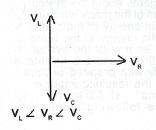
(d) Draw and label one vector diagram for the potential differences across the inductor, the capacitor and the resistor in (c) above.
(b)(i) Explain resonant frequency of an RLC circuit.
(ii) Explain the statement — the power supply voltage of a source is 230V
(c) A source of e.m.f 240V and frequency 50 Hz is connected to a series arrangement of a resistor, an inductor and a capacitor. When the current in the capacitor is 10A, the potential difference across the resistor is 140 V and that across the inductor is 50 V. Calculate the:
(i) potential difference across the capacitor (ii) capacitance of the capacitor; (iii) inductance of the indicator.
(d) Draw and label one vector diagram for the potential differences across the inductor, the capacitor and the resistor in (c) above.
Take Free Practice Test On 2026 JAMB UTME, Post UTME, WAEC SSCE, GCE, NECO SSCE
Correct Answer: Option n
Explanation:
(a)(i) Reactance s the opposition in ohms to the alternating current by an inductor, a capacitor or both.
(ii) Impedance is the total opposition is ohms to the alternating current by a combination of resistor as well as a capacitor or an inductor.
(b)(i) Resonant frequency fo is to frequency at which the current in the circuit has a maximum value. fo = \(\frac{1}{2 \pi LC}\)
(ii) This means that the root mean square value of the voltage is 230v. The actual voltage lies between Vo and -Vo where the voltage amplitude or peak voltage Vo.
(c)(i) \(V^2 = V^2_R + (V_L - V_C)^2; 240^2 = 140^2 + (50 - v_c)^2\);
50 - \(V_c = 194.9\)
\(V_c = 244.9v\)
(ii) X\(_c = \frac{1}{2 \pi fc} = \frac{V}{1} = \frac{1}{2 \pi \times 50 \times c} = \frac{244.9}{10}\)
C = \(\frac{10}{2 \pi \times 50 \times 244.9} = 129.97 \mu F\)
(iii) \(X_L = 2 \pi fL = \frac{v}{l}; 2 \pi \times 50 \times L = \frac{50}{10}\)
L = \(\frac{50}{100x}\)
= 0.01159Hz
(d)
(a)(i) Reactance s the opposition in ohms to the alternating current by an inductor, a capacitor or both.
(ii) Impedance is the total opposition is ohms to the alternating current by a combination of resistor as well as a capacitor or an inductor.
(b)(i) Resonant frequency fo is to frequency at which the current in the circuit has a maximum value. fo = \(\frac{1}{2 \pi LC}\)
(ii) This means that the root mean square value of the voltage is 230v. The actual voltage lies between Vo and -Vo where the voltage amplitude or peak voltage Vo.
(c)(i) \(V^2 = V^2_R + (V_L - V_C)^2; 240^2 = 140^2 + (50 - v_c)^2\);
50 - \(V_c = 194.9\)
\(V_c = 244.9v\)
(ii) X\(_c = \frac{1}{2 \pi fc} = \frac{V}{1} = \frac{1}{2 \pi \times 50 \times c} = \frac{244.9}{10}\)
C = \(\frac{10}{2 \pi \times 50 \times 244.9} = 129.97 \mu F\)
(iii) \(X_L = 2 \pi fL = \frac{v}{l}; 2 \pi \times 50 \times L = \frac{50}{10}\)
L = \(\frac{50}{100x}\)
= 0.01159Hz
(d)