(a) Define the following terms:
(i) Electric field intensity
(ii) Electric potential
(b) The diagram below illustrates two collinear electric charges of magnitudes + Q and -Q. The charges are equidistant from a point P at which a rest charge is placed.
Copy the diagram and use arrows to indicate, from the point P, the direction of the;
(i) electric force F\(_1\) due to + Q.
(ii) electric force F\(_2\) due to -Q.
(iii) electric field intensity E.
(c) What is meant by dielectric substance?
(ii) List the factors which determine the capacitance of a parallel plate capacitor and state the effect each of them has on the capacitance.The diagram above represents a section of a circuit. Calculate the effective capacitance in the section.
(iii)
The diagram above represents a section of a circuit. Calculate the effective capacitance in the section.
(i) Electric field intensity
(ii) Electric potential
(b) The diagram below illustrates two collinear electric charges of magnitudes + Q and -Q. The charges are equidistant from a point P at which a rest charge is placed.
Copy the diagram and use arrows to indicate, from the point P, the direction of the;
(i) electric force F\(_1\) due to + Q.
(ii) electric force F\(_2\) due to -Q.
(iii) electric field intensity E.
(c) What is meant by dielectric substance?
(ii) List the factors which determine the capacitance of a parallel plate capacitor and state the effect each of them has on the capacitance.The diagram above represents a section of a circuit. Calculate the effective capacitance in the section.
(iii)
The diagram above represents a section of a circuit. Calculate the effective capacitance in the section.
Take Free Practice Test On 2026 JAMB UTME, Post UTME, WAEC SSCE, GCE, NECO SSCE
Correct Answer: Option n
Explanation:
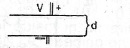
(a)(i) Electric field intensity = Electric force per unit charge OR As negative potential i.e.E = \(\frac{-V}{d}\)
OR E = \(\frac{F}{Q}\). where F is the force,
Q is the charge and E electric field intensity.
(ii) Electric potential =- work done per unit charge to bring a (positive) charge from infinity to a point in an electric field.
(b)
(c) (i) A dielectric substance is any insulating material placed between the plates of a capacitor
C = \(\frac{KE_oA}{A}\)
(iii) C\(_{2.3}\) = C\(_2\) + C\(_3\) = 20 + 20 = 40\(\mu\) F
\(\frac{1}{C_T} = \frac{1}{C_{2.3}} + \frac{1}{C_1}\)
\(C_T = \frac{\frac{C_{2.3} \times C_1}{C_2.3 + C_1} = \frac{40 \times 40}{40 \times 40}\)
= 20\(\mu F\)
(a)(i) Electric field intensity = Electric force per unit charge OR As negative potential i.e.E = \(\frac{-V}{d}\)
OR E = \(\frac{F}{Q}\). where F is the force,
Q is the charge and E electric field intensity.
(ii) Electric potential =- work done per unit charge to bring a (positive) charge from infinity to a point in an electric field.
(b)
(c) (i) A dielectric substance is any insulating material placed between the plates of a capacitor
| (ii) Factors | Effect on capacitor |
| common area of platesDistance between platesNature of dielectric | capacitance increases with areacapacitance decreased with increasing distancecapacitance increases with dielectric constant |
C = \(\frac{KE_oA}{A}\)
(iii) C\(_{2.3}\) = C\(_2\) + C\(_3\) = 20 + 20 = 40\(\mu\) F
\(\frac{1}{C_T} = \frac{1}{C_{2.3}} + \frac{1}{C_1}\)
\(C_T = \frac{\frac{C_{2.3} \times C_1}{C_2.3 + C_1} = \frac{40 \times 40}{40 \times 40}\)
= 20\(\mu F\)