(a) (i) Define uniform acceleration.
(ii) Write an equation that relates linear velocity, angular velocity and radius
of path in circular motion.
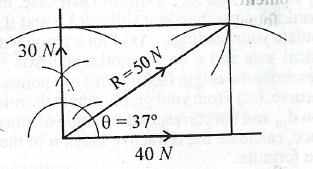
(b) Two forces 30 N and 40 N act at right angles to each other. Determine by scale drawing, the magnitude and direction of the resultant force,.using a scale of 1 cm to 5 N.
(c) Explain why ships are usually refilled with sand and water after they have been emptied of their cargo.
(d) A crate of drinks of mass 20 kg is placed on a plane inclined at 30° to the horizontal. If the crate slides down with a constant speed, calculate the:
(i) co-efficient of kinetic friction;
(ii) magnitude of the frictional force acting on the crate. [ g = 10 ms\(^{-2}\)]
(ii) Write an equation that relates linear velocity, angular velocity and radius
of path in circular motion.
(b) Two forces 30 N and 40 N act at right angles to each other. Determine by scale drawing, the magnitude and direction of the resultant force,.using a scale of 1 cm to 5 N.
(c) Explain why ships are usually refilled with sand and water after they have been emptied of their cargo.
(d) A crate of drinks of mass 20 kg is placed on a plane inclined at 30° to the horizontal. If the crate slides down with a constant speed, calculate the:
(i) co-efficient of kinetic friction;
(ii) magnitude of the frictional force acting on the crate. [ g = 10 ms\(^{-2}\)]
Take Free Practice Test On 2026 JAMB UTME, Post UTME, WAEC SSCE, GCE, NECO SSCE
Correct Answer: Option n
Explanation:
(i) Uniform acceleration is a constant time rate of increase in velocity.
(ii) Linear velocity = angular velocity x radius of path V = \(\omega\)r
(b) Scale: 1 cm to 5 N
30N = 6cm and 40N = 8cm
(c) A floating ship is balanced by its weight and the upthrust on it. Hence when off-loaded the upthrust becomes greater than the weight of the ship, therefore when refilled with sand and water, equilibrium is restored for stability.
d)(i) \(\mu = tan \theta = tan 30^o = 0.5774\)
(ii) F = \(\mu g cos \theta\) = 0.5774 x 20 x 10 x Cos 30\(^o\) = 100N
(i) Uniform acceleration is a constant time rate of increase in velocity.
(ii) Linear velocity = angular velocity x radius of path V = \(\omega\)r
(b) Scale: 1 cm to 5 N
30N = 6cm and 40N = 8cm
(c) A floating ship is balanced by its weight and the upthrust on it. Hence when off-loaded the upthrust becomes greater than the weight of the ship, therefore when refilled with sand and water, equilibrium is restored for stability.
d)(i) \(\mu = tan \theta = tan 30^o = 0.5774\)
(ii) F = \(\mu g cos \theta\) = 0.5774 x 20 x 10 x Cos 30\(^o\) = 100N