(a) With the aid of a well-labelled diagram, describe a typical soil profile
(b) Highlight the importance of soil Use the climatic data in the table below to answer the following questions
(b) Highlight the importance of soil Use the climatic data in the table below to answer the following questions
Take Free Practice Test On 2026 JAMB UTME, Post UTME, WAEC SSCE, GCE, NECO SSCE
Correct Answer: Option n
Explanation:
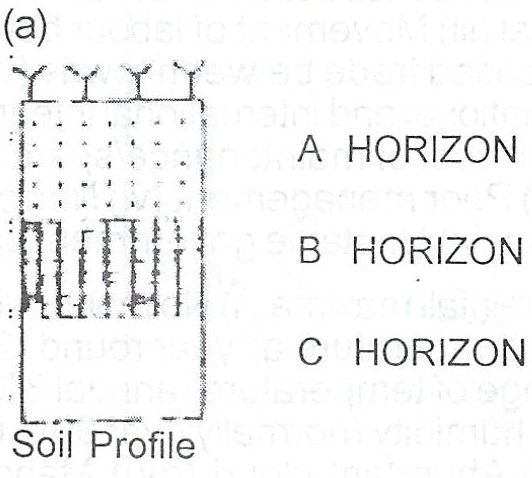
The description of a soil profile.
A Horizon (Zone of eluviation): It is the surface or top soil. This is the zone where organic materials have become incorporated within the mineral matter. the zone of eluviation has little of fresh plant remains at the surface but below is a layer of very dark humus. Below the humus, is a light coloured mineral layer produced from leaching. This zone supports maximum biological activity of plants or micro-organisms hence a considerate part of the nutrients and water available for plants are found. The most extensive roots developed in this zone support life
B Horizon (Zone of illuviation): This is the subsoil which is lighter in colour because it contains less humus. It also contains little organic material unit which makes the mineral matter weathered Zone of illuviation contains substances derived from the A horizon through leaching and some substance derived from the C horizon through evaporation. Clay is also washed down from the surface. The major mineral compounds that accumulate in this zone include iron, calcium and aluminum.
C Horizon: The C horizon is the regolith composed of the same parent materials. The true soil above developed from it because it is more.or less weathered. This zone is mostly solid hence it is regarded as the reservoir of minerals.
(b)(i) It is the main medium of plant growth
(ii) It is the habitat for micro-organisms, reptiles and some animals
(iii) It serves as raw materials for industries e.g sand, clay, limestone, etc
(iv) It serves as determinants of the type of agriculture
(v) It serves as support for building
(vi) It contains all the essential minerals
(vii) Soil serves as food for micro-organisms such as earthworm
The description of a soil profile.
A Horizon (Zone of eluviation): It is the surface or top soil. This is the zone where organic materials have become incorporated within the mineral matter. the zone of eluviation has little of fresh plant remains at the surface but below is a layer of very dark humus. Below the humus, is a light coloured mineral layer produced from leaching. This zone supports maximum biological activity of plants or micro-organisms hence a considerate part of the nutrients and water available for plants are found. The most extensive roots developed in this zone support life
B Horizon (Zone of illuviation): This is the subsoil which is lighter in colour because it contains less humus. It also contains little organic material unit which makes the mineral matter weathered Zone of illuviation contains substances derived from the A horizon through leaching and some substance derived from the C horizon through evaporation. Clay is also washed down from the surface. The major mineral compounds that accumulate in this zone include iron, calcium and aluminum.
C Horizon: The C horizon is the regolith composed of the same parent materials. The true soil above developed from it because it is more.or less weathered. This zone is mostly solid hence it is regarded as the reservoir of minerals.
(b)(i) It is the main medium of plant growth
(ii) It is the habitat for micro-organisms, reptiles and some animals
(iii) It serves as raw materials for industries e.g sand, clay, limestone, etc
(iv) It serves as determinants of the type of agriculture
(v) It serves as support for building
(vi) It contains all the essential minerals
(vii) Soil serves as food for micro-organisms such as earthworm