(a) Define uniform acceleration.
(b) Forces act on a car in motion. List the
(i) horizontal forces and their directions;
(ii) vertical forces and their directions
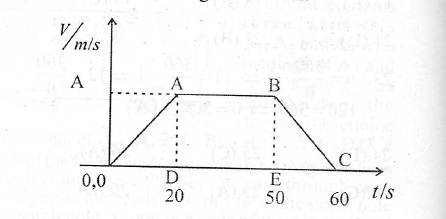
(c) A car starts from rest and accelerate uniformly for 20s to attain a speed of 25 ms\(^{-1}\). It maintains this speed for 30s before decelerating uniformly to rest. The total time for the journey is 60s.
(i) Sketch a velocity-tune graph for the motion.
(ii) Use the graph to determine the (\(\alpha\)) total distance travelled by the car (\(\beta\)) deceleration of the car.
The figure here illustrates force-extension graph for a stretched spiral spring. Determine the work done on the spring.
(b) Forces act on a car in motion. List the
(i) horizontal forces and their directions;
(ii) vertical forces and their directions
(c) A car starts from rest and accelerate uniformly for 20s to attain a speed of 25 ms\(^{-1}\). It maintains this speed for 30s before decelerating uniformly to rest. The total time for the journey is 60s.
(i) Sketch a velocity-tune graph for the motion.
(ii) Use the graph to determine the (\(\alpha\)) total distance travelled by the car (\(\beta\)) deceleration of the car.
The figure here illustrates force-extension graph for a stretched spiral spring. Determine the work done on the spring.
Take Free Practice Test On 2026 JAMB UTME, Post UTME, WAEC SSCE, GCE, NECO SSCE
Correct Answer: Option n
Explanation:
(a) Uniform acceleration is the constant time rate of increase in velocity.
(b) (i) Horizontal Force;
Forward force - Thrust
backward force - Frictional force
(ii) Vertical Force
Upward force - Normal reaction.
Downward force - Weight of the car.
(c)
(ii) (\(\lambda\)) Total distance
= Area of trapezium OABC
= \(\frac{1}{2}\)[AB + OC] AD
= \(\frac{1}{2}\)[60+30] x 25
=1125m
(\(\beta\)) Deceleration = slope of BC
= \(\frac{BE}{CE} = \frac{25}{10}\)
= 25m/s\(^2\)
(d) Work done = \(\frac{1}{2}\)Fe
= \(\frac{1}{2}\) x 12 x \(\frac{0.5}{100}\)J
= 0.03J
(a) Uniform acceleration is the constant time rate of increase in velocity.
(b) (i) Horizontal Force;
Forward force - Thrust
backward force - Frictional force
(ii) Vertical Force
Upward force - Normal reaction.
Downward force - Weight of the car.
(c)
(ii) (\(\lambda\)) Total distance
= Area of trapezium OABC
= \(\frac{1}{2}\)[AB + OC] AD
= \(\frac{1}{2}\)[60+30] x 25
=1125m
(\(\beta\)) Deceleration = slope of BC
= \(\frac{BE}{CE} = \frac{25}{10}\)
= 25m/s\(^2\)
(d) Work done = \(\frac{1}{2}\)Fe
= \(\frac{1}{2}\) x 12 x \(\frac{0.5}{100}\)J
= 0.03J